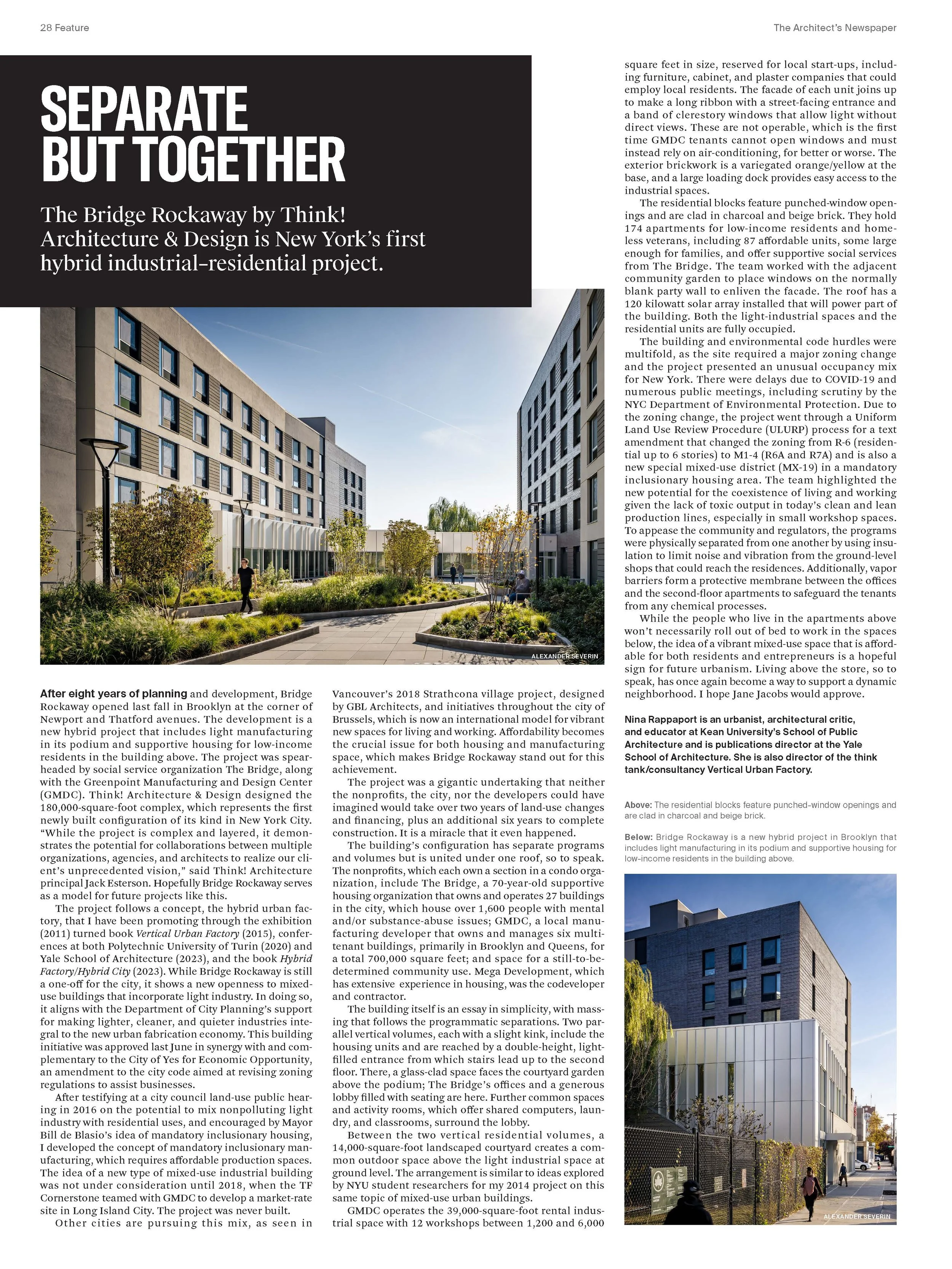
The Architect’s Newspaper recently ran a feature entitled, New York is Now!, which focuses on projects in New York that are approaching development from a different perspective. The feature includes a piece about Bridge Rockaway - the first-of-its-kind New York City development combining supportive housing with light manufacturing, designed by Think!
The article, written by Nina Rappaport, discusses how the project demonstrates a growing openness to mixed-use buildings that integrate clean, small-scale industry, supported by recent zoning changes and the broader push for an urban fabrication economy. Despite significant regulatory, construction, and financing challenges, the complex provides affordable homes, supportive services, and production space for local entrepreneurs, offering a promising model for future hybrid urban development and a driver of neighborhood jobs and economic growth.
Construction has topped out at Glenmore Manor in Brownsville, Brooklyn. Designed for Brisa Builders, Lemle & Wolff Companies; and the African American Planning Commission, the project will create 233 apartments serving low income families, formerly homeless individuals and low-income seniors.
Located at the intersection of Christopher and Glenmore Avenues, the development is one of several residential components in the Brownsville Neighborhood Plan, an initiative to revitalize and invigorate the surrounding area.
This critically needed project incorporates the key goals of the Plan including commercial and community facilities to create a center for innovation and local entrepreneurship. Its purpose is to energize the neighborhood providing new jobs and opportunities. This center is conceived as a 20,000 sq ft two story, highly transparent element known as the B’Ville Hub. Above the Hub, the building’s façade is composed of glazed blue and dark metal trim, with green roofs and solar panels to enhance the project’s sustainability.
The overall design builds on opportunities within the existing urban landscape, strategically locating building mass, storefronts and entrances to strengthen pedestrian corridors and create diverse opportunities for social and economic activities.